
Checking Criminal History in Fort Mill
A Fort Mill criminal record search works best when the request starts at the town level. The Fort Mill Police Department holds reports created by its officers. The Municipal Court handles its local docket, warrants, and ticket transactions. A county or state source answers a different question. The town itself directs statewide history requests to SLED, so a police report request should not be mistaken for a full South Carolina history.
- Ask the Fort Mill records clerk for the incident or arrest report made by town police.
- Use the town FOIA form when the item is not routinely released through the records clerk.
- Check Fort Mill Municipal Court for its local case, warrant, or ticket transaction.
- Use the York County roster and court system when custody or prosecution has moved beyond the town.
- Use SLED CATCH for a statewide, fingerprint-supported South Carolina name report.
Begin a Fort Mill search with a case number, report number, ticket number, or exact name when one is known. Then compare dates and outcomes. A Fort Mill report records what police alleged. A court docket records what was filed and resolved. The broader York County criminal history overview explains the county and state layers in more depth.
Fort Mill Records Under One Roof
Fort Mill changed its civic record geography in 2025. Town Hall, Police, Municipal Court, and Council Chambers moved together to 205 North White Street. That shared site reduces one common source of confusion: the police report counter and the local court are part of the same civic complex, though each office still keeps a distinct record. The Police Department reports 85 sworn and 15 civilian staff. Court staff, not police staff, process court payments and docket work.
The official Fort Mill Police page shows the local public-safety office used for report questions.
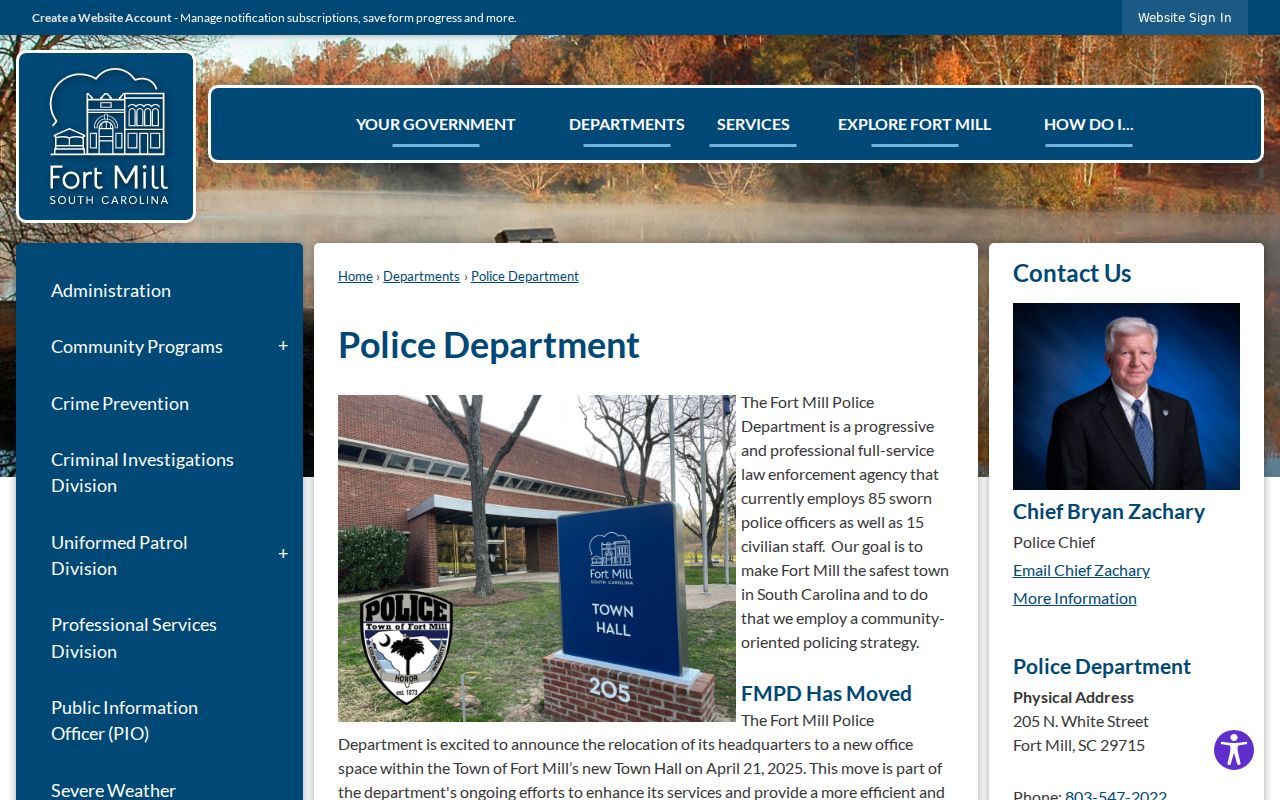
This view helps a requester confirm the right Fort Mill agency before asking for a Fort Mill police record.
Fort Mill Police Department Records
Fort Mill Police creates the incident or arrest narrative when its officers respond. The department FAQ routes an incident-report request to records clerk bellis@fortmillsc.gov. It sends a person seeking a statewide history to SLED instead. That distinction matters. The local report may describe the time, place, alleged conduct, officer, and initial charge, but it is not a complete statewide identity history and does not prove a conviction.
The Fort Mill department is at 205 North White Street, Fort Mill, SC 29715, and its main number is 803-547-2022. Collision reports use another route. Fort Mill directs those requests to SCDMV and says they are generally available after five to ten business days. A Fort Mill collision form should not be treated as a criminal-history report merely because police responded.
Fort Mill Police Department
205 North White Street
Fort Mill, SC 29715
803-547-2022
Incident reports: bellis@fortmillsc.gov
Fort Mill Police FOIA Fields
The Fort Mill online FOIA form is the fallback for Fort Mill records not routinely supplied by the records clerk. Submission itself is free, but producing, searching, or redacting responsive records may cost money under the stated rules. Fort Mill gives two controls at the end: Submit and Submit and Print. Keeping the printed copy preserves the wording and date of the Fort Mill request.
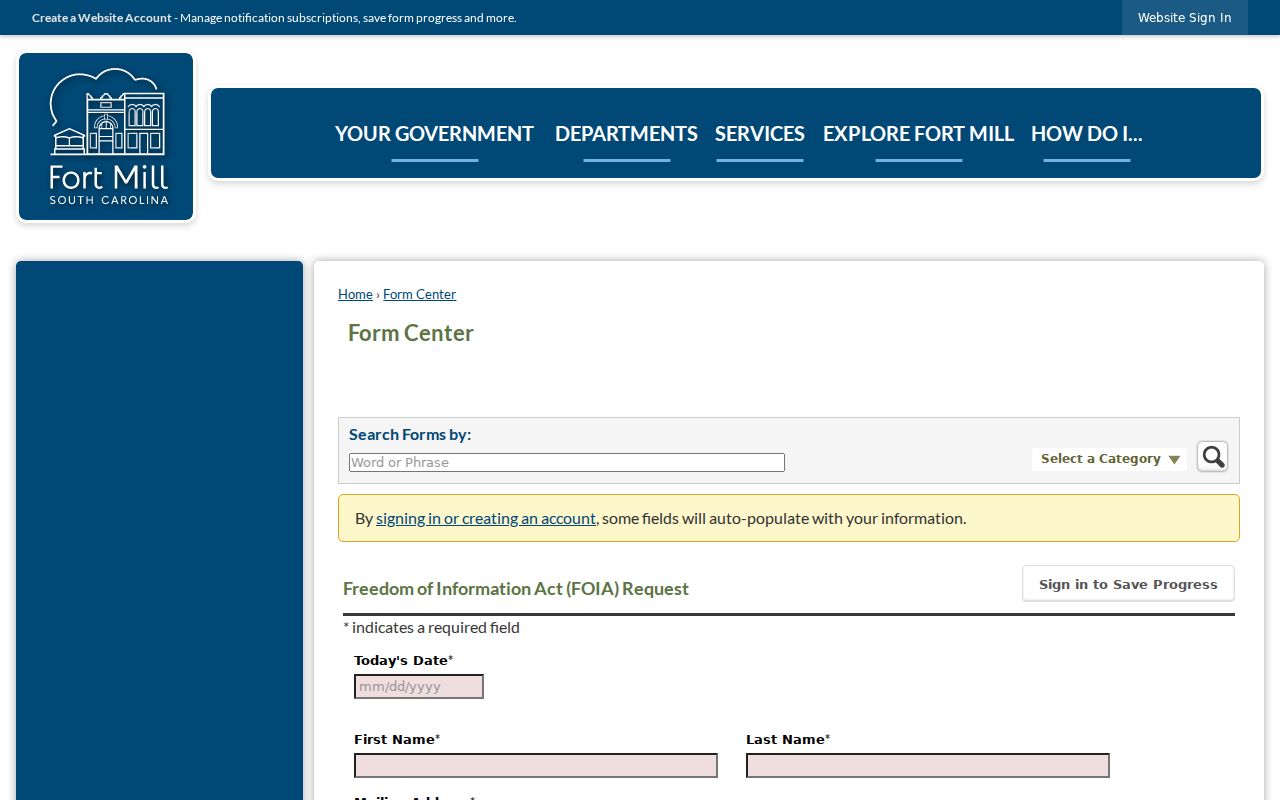
The captured form shows why a complete description and a clear delivery choice can make a local records request easier to route.
| Form group | Fort Mill fields or choices |
|---|---|
| Requester | Today’s Date, first and last name, mailing address, city, state, ZIP, phone, and email |
| Record | Description and Department Requested, with the department field not marked required |
| Delivery | Mail, email, Town Hall pickup, or Police pickup |
| Certification | Commercial/business answer, legal and fee acknowledgement, and digital signature |
Fort Mill states that it will determine availability within ten business days for newer records and twenty business days for records older than twenty-four months. That is a determination period, not a promise that every requested file will arrive by then.
Fort Mill Arrests and Bookings
No inspected official Fort Mill page identified a city holding facility. No written Fort Mill holding agreement was identified that says every town arrest follows one fixed transfer process. It would therefore be inaccurate to describe a guaranteed or immediate move to the county jail. The verified Fort Mill follow-up is the York County current-inmate roster because YCSO says its detention system holds people arrested by agencies across the county.
If a name is not on the roster, call the YCDC booking and release line at 803-628-3083, option 2. Absence can reflect a release, transfer, spelling issue, or a gap between arrest and roster display. Ask Fort Mill Police for its report as a separate step. For a filed charge, use Fort Mill Municipal Court or the county Public Index according to the court that received the case. The county Arrest Lookup covers current custody and agency-request routes in more detail.
Note: Fort Mill’s lack of a published city holding agreement is an evidence limit, not proof that county booking never occurs.
Fort Mill Court Record Sessions
Fort Mill Municipal Court lists Wednesday sessions at 10 a.m. and 5 p.m. Chief Municipal Judge Colin Okoye presides, and Clerk Josh Handley manages the clerk function. The court number is 803-396-0150, and its fax is 803-547-2039. These details help a reader distinguish the court from the Police Department even though both now share the North White Street site.
The official Fort Mill Municipal Court page provides the current session and contact details.
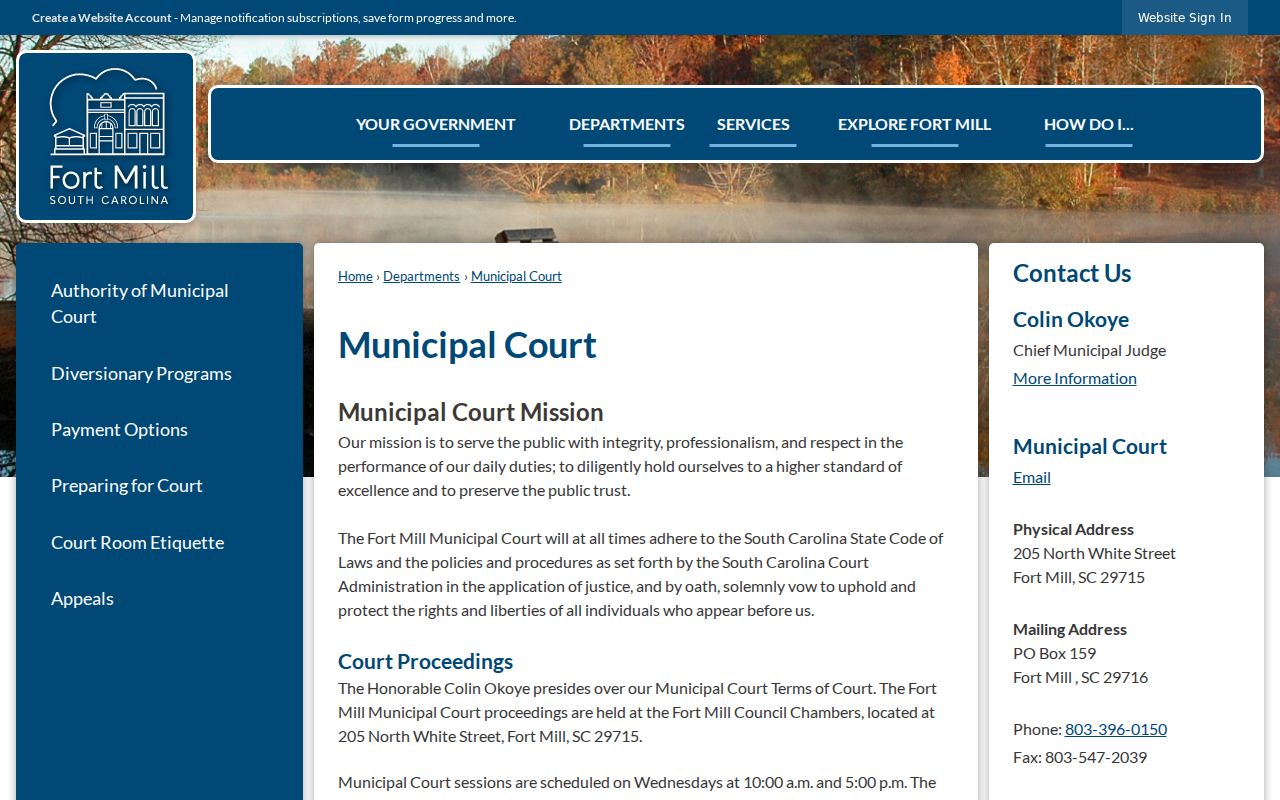
The page is the right checkpoint before relying on an old court date or sending a payment to the wrong town office.
Municipal Court Records in Fort Mill
Fort Mill Municipal Court maintains local criminal and traffic matters within its jurisdiction. The clerk processes warrants and docket transactions. A case record may show the initiating ticket or warrant, party name, court action, payment status, and disposition as the clerk enters them. The court file answers what happened in court; it does not replace the police narrative or the statewide SLED history.
| Court Name | Fort Mill Municipal Court |
|---|---|
| Case Types Heard | Town ordinance, traffic, and limited state criminal matters within municipal jurisdiction |
| Case Lookup Channel | SC.gov payment lookup, Municipal Court clerk, and South Carolina Public Index where available |
| What the Docket Shows | Case or ticket identifiers, court transactions, payment information, and recorded outcome where entered |
| Copies & Fees | Ask the clerk; no current official Fort Mill court-copy fee was identified |
A Fort Mill case that falls outside municipal jurisdiction can move into York County General Sessions or another proper court. Municipal Public Index coverage is not universal. When the online result is absent, the Fort Mill clerk remains the direct source.
Fort Mill Ticket Record Delays
The state’s official town-payment route can show “No records found” even when a Fort Mill ticket exists. The town says tickets may take three to five business days to load. First select Fort Mill, accept the disclaimer, enter the case or ticket number without spaces, add the last name, and choose Locate Case. Review the result before using Confirm Payment. If the record still does not appear, contact the municipality rather than changing the number at random.
The official South Carolina court-payment route displays the town selection and transaction flow.
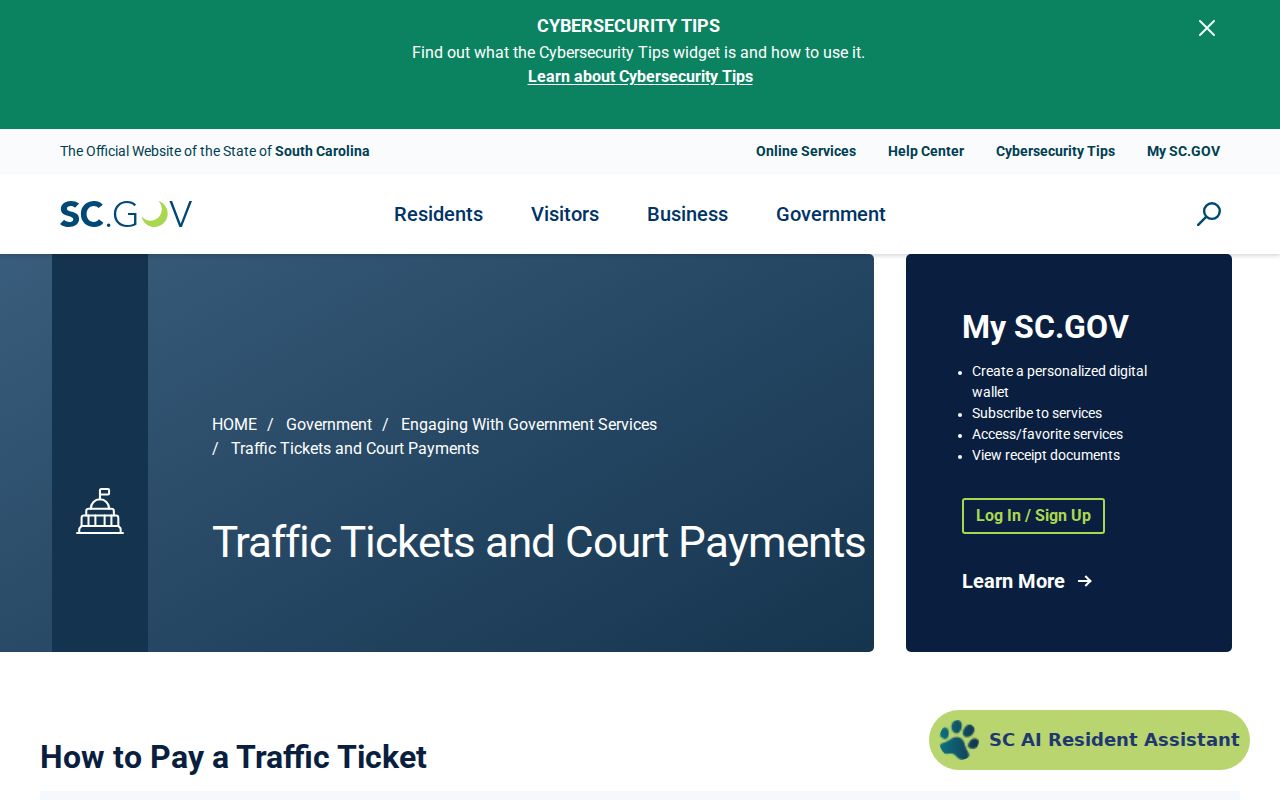
This image connects a missing online result to the published upload lag and the clerk fallback, not to a claim that the case was cleared.
Some Fort Mill matters require a court appearance and cannot be resolved as a simple online payment. In-person payments are cash or money order during the court’s published hours. Fort Mill Police does not take court payments.
Where Fort Mill Records Go
Fort Mill Police keeps the originating incident or arrest report. The proper municipal or county court records the charge, actions, and disposition. Custodial fingerprints from a booking must reach SLED’s Central Record Repository within three days, excluding weekends and holidays. Court officials also report later case data. That path explains why a fresh local record may appear before the statewide history has a final outcome.
Record flow: Fort Mill Police Department › York County Courts › South Carolina Law Enforcement Division
Fort Mill searchers should compare the stages instead of forcing them into one record. A Fort Mill police report shows the original allegation. A roster entry concerns custody. A docket shows the filed case. SLED CATCH compiles fingerprint-supported South Carolina arrest and conviction information and can still lack a reported disposition. Names, aliases, and dates must be compared with care.
Fort Mill Record Growth Context
U.S. Census Bureau Vintage 2024 estimates rank Fort Mill as York County’s second-largest incorporated city, with 36,244 residents. The Fort Mill estimate stood 47.8 percent above its 2020 estimate base. That sharp Fort Mill growth offers useful context for the shared Town Hall, court, and police complex. It does not establish a crime rate or show that a particular type of case increased. Fort Mill did not publish a comparable numeric crime report in the inspected sources, so no local crime total should be inferred.
The Census city and town estimates supply the official population source used for this context.

The population source explains changing service demand without turning demographic growth into an unsupported claim about Fort Mill criminal records.
Public Access Rules in Fort Mill
Fort Mill police and town records are subject to the South Carolina Freedom of Information Act, but public access is not unlimited. An agency may redact or withhold protected personal identifiers, victim details, juvenile material, active investigative facts, and other exempt content. The town may charge reasonable actual costs for search, redaction, and production. A public arrest report still does not establish guilt, and a name match is not enough to establish identity.
Key Statutes:
South Carolina Freedom of Information Act permits inspection and copying of nonexempt public records while preserving listed exemptions.
S.C. Code §§23-3-115 and 23-3-120 govern SLED dissemination and the reporting of fingerprints and criminal data.
S.C. Code §§17-22-910 through 17-22-950 set the authorized paths for expungement of eligible matters.
An expunged, juvenile, or otherwise restricted Fort Mill record may not appear through ordinary public channels. If an eligible Fort Mill record has been cleared, verify the result with the originating court and SLED rather than assuming that one empty search confirms every agency copy was handled.
Fort Mill Records and Place
Fort Mill incorporated in 1873, but its local story reaches from Catawba homeland and Scotch-Irish settlement through the rail and textile eras. Nation Ford Road, the Catawba River, U.S. 21, and I-77 shaped how the town grew. The Paradise neighborhood began in the 1890s as a predominantly African-American community. These facts matter to historical and genealogy work because an old Fort Mill event may be described by a road, neighborhood, town office, or court system that does not match today’s civic layout.
Modern Fort Mill criminal records remain split by custodian despite the shared Fort Mill complex. A local historian may need Fort Mill for a police or ordinance record, the Fort Mill court clerk for the docket, and York County or South Carolina for a later custody or repository record. Place and date guide the search more reliably than the town name alone.